A Season in Provence
On light, landscape and the rhythms of life in the south of France.
In Provence, the morning often begins with the scent of bread.
Walking through the village before the heat has gathered, I pass the boulangerie, where the warmth of freshly baked baguettes drifts through the doorway. There is the deeper, toasted scent of the crust, followed by the delicate sweetness of butter and pastry. Occasionally, something fruitier rises above the warmth, perhaps raspberry syrup or the delicate layers of a mille-feuille à la framboise with fresh raspberries.
Inside, a familiar exchange of bonjour, bonjour passes between the baker and those arriving for their morning bread. Croissants are arranged in rows, their golden layers catching the light, while paper bags rustle across the counter.
Outside, shutters are opening, the stone buildings are still cool from the night, and the first sunlight reaches across the narrow streets.
I have grown to love these early hours, particularly in summer, when the day changes character so quickly.
By late morning, the sun is high, the pavements are hot beneath my feet, and the air has lost its freshness. I learned that arriving at the boulangerie at 11:55, hoping to buy something before the midday closure, was not necessarily appreciated. Although the clock suggested there were still five minutes remaining, the morning's work was already coming to an end.
The baker had begun long before most of the village was awake. By noon, the shutters were ready to close.
In the smaller places I know, the hours between twelve and two often bring a pause in the working day. During the height of summer, when the heat is at its most intense, some shops close and the streets become noticeably less busy. The midday break is part of the familiar rhythm of life, particularly during the long, hot weeks of a southern European summer.
I have come to appreciate this adjustment to the day. There is a practical understanding behind it, shaped by the climate and carried through generations.
The landscape itself reflects a similar understanding.
On the way home, I travel beneath long avenues of plane trees that border the roads, their branches extending overhead to form a broad canopy of shade. During the hottest part of summer, the difference beneath them is immediately noticeable. Sunlight filters through the leaves, scattering moving patches of brightness across the road.
I am especially drawn to their bark.
The outer layers peel away in irregular shapes, revealing a patchwork of cream, pale grey, olive and soft brown. Some trunks are almost white in places, while others carry darker markings that resemble the surface of weathered stone. As the light changes, the colours become more or less pronounced, and each tree seems to have its own arrangement of shapes.
The plane trees are beautiful, but their presence is also practical. Their generous canopies have provided shade along roads and public spaces for generations. They belong to a landscape in which people have long considered how to live with the summer sun.
Beyond these shaded roads, the countryside opens into orchards, vineyards and fields that change with the seasons.
Rows of apple trees stand beside orchards of peaches and apricots, while almond trees, olive groves and vineyards extend across the land. In summer, fields of sunflowers bring broad stretches of yellow to the landscape, their tall stems rising above the dry earth.
By autumn, much of the harvest has passed. The vineyards begin to change colour, the fruit trees gradually lose their leaves, and the olive groves retain their silvery green against the surrounding fields.
Along the edges of the orchards stand tall rows of cypress trees, planted closely together to form dense windbreaks. Their dark foliage rises above the fruit trees, creating long vertical lines across the countryside.
During summer, I notice the geometry of these plantings: the repeating rows of trees, the carefully tended vineyards and the cypress hedgerows dividing the fields. As autumn advances and the winds strengthen, the purpose of those hedgerows becomes more apparent.
When the mistral sweeps across Provence, the cypress trees help shelter the orchards from its force. The wind can arrive with remarkable strength, clearing the atmosphere and bringing a sharpness to the air. The dense hedgerows interrupt its passage across the open land, offering protection to the smaller trees growing behind them.
I find these rows of cypress particularly beautiful. Their dark foliage stands against the pale earth and distant hills, giving the countryside a structure that is visible from far away.
Like the plane trees lining the roads, they reveal how the landscape has been shaped by human knowledge of the seasons.
One provides shade during the summer heat. The other offers shelter from the wind. Both have been planted with an understanding of the conditions in which people live and cultivate the land.
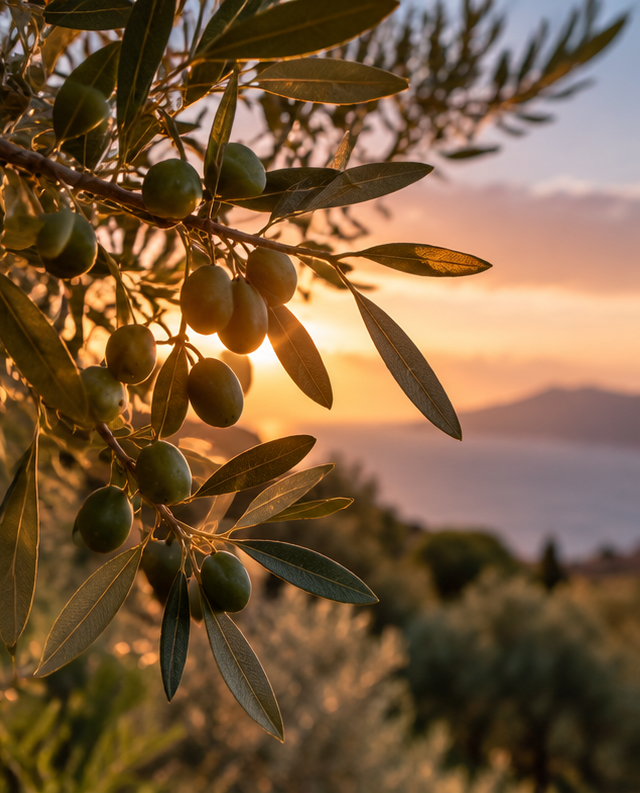
What I love about Provence is the softness of its light, particularly towards the end of the afternoon. The colours take on a dusty pastel quality. Distant hills appear in muted shades of lavender and blue, the limestone becomes pale cream or pink, and the olive trees hold their silvery foliage against the warmer earth.
I can understand why artists have been drawn to this region for so long. Cézanne's landscapes and Van Gogh's paintings of southern France reveal different responses to the colours and atmosphere of a place that changes continually with the hour and the season.
Sometimes, looking across the hills, I find myself thinking about how difficult it would be to capture those colours precisely. The grey of an olive leaf contains hints of green and silver. The pale stone carries warmth beneath its surface. Even the shadows have colour.
As summer gives way to autumn, the mornings become cooler and the intensity of the afternoon heat gradually eases. At the markets, baskets of peaches, tomatoes and courgettes begin to share space with figs, grapes, squash and chestnuts.
The scent of the countryside changes after the first substantial rains. Dry earth darkens, the vegetation releases a different fragrance, and the dust that has settled along the roads through summer is washed away.
These details have become part of how I recognise Provence.
The smell of bread in the morning, the closing shutters at midday, the shade beneath the plane trees and the orchards stretching across the countryside. Then, as autumn arrives, the first rains, the changing produce at the markets and the movement of the cypress hedgerows in the wind.
I have spent enough time here to know that the landscape cannot be understood through a single season. The Provence of July, with its intense sunlight and dry earth, feels quite different from the Provence of November, when the days are shorter and the countryside begins to recover from the heat of summer.
Returning at different times of year has changed how I see it. I notice the same trees in different weather, the same roads beneath a changing sky, and the small adjustments in daily life that accompany the seasons.
By late afternoon, the light begins to soften once more. Across the limestone hills, the pale cream of midday gradually gives way to warmer shades of rose and ochre. The distant ridges take on a faint lavender hue, while the hollows between them deepen into blue-grey shadow.
I have watched these hills at different hours and through different seasons, yet their colours still surprise me. After rain, the limestone can appear almost white beneath a clearing sky. On a dry summer evening, it holds the warmth of the setting sun, its surface taking on the dusty pastel shades I have come to associate with Provence.
As the sun lowers, the colours change again, until the last warmth disappears from the stone and the hills settle into the approaching evening.