The Autumn Table
On the harvest, the pleasure of fresh nuts and the traditions we carry forward.
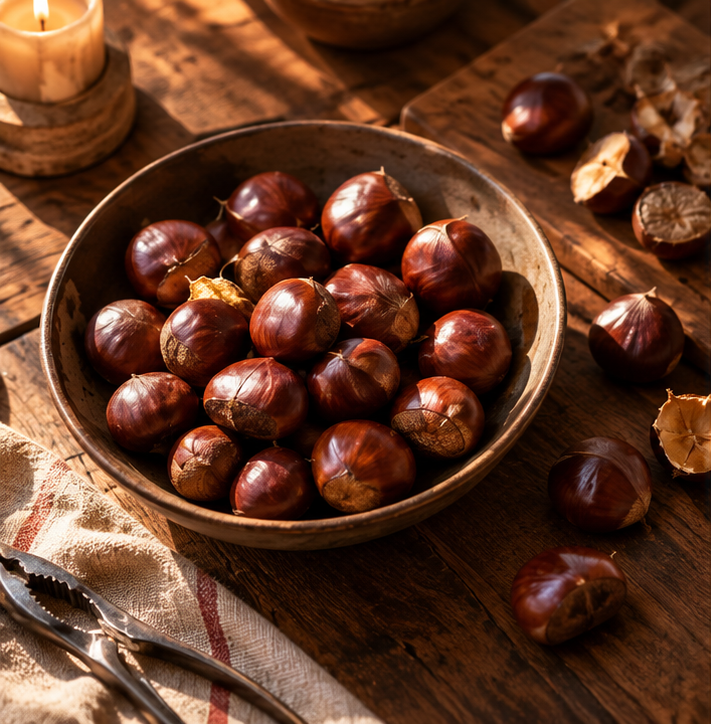
I have spent entire afternoons on the terrace in Provence cracking hazelnuts with a small hammer.
The nutcracker is somewhere in the house, although finding it can sometimes take longer than gathering the nuts themselves. So I settle down with the hammer, a bowl for the kernels and another for the broken shells.
Some shells split neatly. Others require several attempts, and occasionally the nut inside breaks into pieces. After an hour or two, the pile of shells has grown considerably, while the bowl of hazelnuts seems remarkably small in comparison.
The nuts come from a tree in my garden, where a large chestnut tree also grows. Through summer, the hazelnuts develop among the leaves, and towards the end of the season I begin looking for those ready to gather.
I enjoy knowing that they have come from a tree growing a few steps from the terrace. But gathering them is the easy part. By the time I have worked through a bowl with the hammer, I have a much greater appreciation for the labour involved in bringing even the simplest ingredients to the table.
Earlier in the year, fresh almonds are another pleasure of Provence.
I find them far more delicious than the dried almonds we buy throughout the year. Their elongated, pointed outer coverings can be opened with my hands, revealing a tender almond inside. The flavour is delicate and fresh, with a gentle sweetness and a softer texture than the familiar dried kernel.
I love eating them at this stage, before the shell has fully hardened. Their flavour is quite different from the almonds we usually encounter, and their season is relatively brief.
Almond trees are among the early signs of spring in Provence. Their pale blossoms appear while much of the countryside is still emerging from winter, often before the leaves have fully developed.
As the season advances, the young almonds form within their soft outer hulls. Gradually, the shells harden and the kernels lose moisture, eventually becoming the almonds that can be dried and stored for many months.
The dried almond has its own qualities, particularly in cooking, but I look forward to the fresh ones. Their tenderness and delicate flavour are difficult to reproduce once the season has passed.
By autumn, the markets have changed considerably.
The peaches and apricots of summer become less abundant, while grapes, figs, walnuts, hazelnuts and chestnuts begin to appear. The colours deepen into russet, purple, gold and dark green, and the ingredients suggest a different approach to cooking.
Chestnuts have a history that extends far beyond their place in today's seasonal markets.
Unlike almonds and hazelnuts, which are rich in oils, chestnuts contain considerably more starch. When cooked, their pale flesh becomes soft and slightly sweet, making them suitable for both savoury dishes and preparations that might otherwise use grain.
Across parts of southern Europe, particularly in mountainous regions where cultivating cereals was difficult, chestnut trees once provided an important source of food.
The nuts could be dried, ground into flour and stored through winter. They were used in breads, porridges and other simple dishes, helping sustain communities during months when fresh produce was less readily available.
In some regions, the chestnut tree became known as the bread tree, reflecting the importance of its harvest as a dependable source of nourishment through the colder months.
I find this history fascinating because it changes how I think about an ingredient.
A chestnut may now be something I choose for its flavour, but for earlier generations the harvest could represent a substantial part of the year's food supply. Gathering, drying, storing and preparing the nuts required knowledge passed through families and communities.
My afternoons with the hazelnuts offer a very small glimpse of that work.
A few hours with a hammer are enough to remind me how convenient it is to open a packet of prepared nuts. We rarely see the labour involved in harvesting, shelling and processing the ingredients that arrive in our kitchens.
Modern food production has made an extraordinary variety of foods available with very little effort from the person buying them. I appreciate that convenience, particularly when time is limited.
Yet preparing something from the beginning changes how I experience it.
I become more conscious of the quantity gathered, the time involved and the care required to avoid wasting what I have collected.
In the kitchen, I enjoy using nuts in simple ways.
Hazelnuts can be lightly toasted to deepen their flavour, then scattered over roasted vegetables or added to a salad. Almonds bring texture to dishes made with seasonal greens, while chestnuts are particularly good in soups and autumn cooking.
I enjoy making chestnut soup as the weather begins to cool. The ingredients need little embellishment: chestnuts, onion, perhaps some leek or celery, vegetable stock and herbs.
Sometimes I add mushrooms, whose deeper, earthy flavour works beautifully with the sweetness of the chestnuts.
The soup is substantial without being heavy, and its flavour suits the cooler months.
What interests me about these ingredients is how differently they have been used according to place and tradition.
In Provence, almonds appear in both sweet and savoury cooking, while chestnuts are associated with the wooded hills and food traditions of the region. Hazelnuts find their way into baking, confectionery and everyday dishes.
Across the Mediterranean and further north, the same ingredients have developed different culinary histories, influenced by what could be grown locally and how food needed to be preserved.
These traditions were shaped by necessity as much as taste.
Before refrigeration and modern transport, households depended more heavily upon what could be gathered, grown and stored. Drying nuts and fruit, preserving vegetables and making use of seasonal abundance were practical skills.
Recipes developed around those conditions, often using ingredients that could be kept through winter or prepared with relatively simple equipment.
I am interested in how much of that knowledge remains in our kitchens today.
We may prepare a dish because we enjoy its flavour, without knowing that its origins lie in the need to preserve a harvest or make a limited supply of food last through the colder months.
A chestnut soup, a loaf made with nut flour or a handful of toasted hazelnuts can carry a history far older than the recipe we happen to be following.
The seasons also influence what I want to eat.
During the heat of a Provençal summer, I am drawn towards fresh vegetables, fruit and lighter meals. As autumn approaches and the evenings become cooler, I begin using the oven more frequently and preparing soups, roasted vegetables and dishes with deeper flavours.
The change happens gradually, following the weather and the ingredients available.
I enjoy anticipating the return of foods that belong to a particular time of year. The first figs, the fresh almonds of spring, the autumn chestnuts and the vegetables that become more abundant as winter approaches.
Their limited availability gives each a place within the year.
I think about this when I return to the terrace with another bowl of hazelnuts.
The hammer is not an especially efficient tool. Occasionally a shell breaks into several sharp pieces, and the kernel needs to be carefully separated from the fragments. Progress is slow, and I sometimes wonder whether I would be better off searching the house once more for the nutcracker.
Yet I continue until the bowl is finished.
Later, when I use those hazelnuts in the kitchen, I remember the tree they came from and the time spent preparing them.
The quantity may be modest, but I know exactly what it took to produce it.
And when I come across fresh almonds at the market, I am reminded again how different an ingredient can be when eaten close to its harvest, before drying and storage have changed its texture and flavour.
The trees, the harvest, the methods of preservation and the recipes developed over generations are all part of what eventually reaches our table.
As the afternoon light moves across the terrace, I gather the empty shells and put away the hammer. The hazelnuts are ready for the kitchen, and the next time I need them, I will have the pleasure of reaching for a bowl of nuts gathered from my own garden.